Everything We Learned About 'Elkhorn' Season 2 During Our Visit To The Set
- Collider
- Oct 1, 2025
- 9 min read
Westerns have a long and storied history in film and TV history, from John Ford's foundational classics like Stagecoach and The Searchers to the best of the Spaghetti Westerns, to Taylor Sheridan's growing Yellowstone universe. The genre has proven perennially popular thanks to themes like the difficulties of surviving on the land, political corruption, crime, or notions of frontier justice, where the only thing standing between you and destruction is the range of your rifle.
Elkhorn, an increasingly popular Western series from producer Gary Tarpinian, centers on famed U.S. President and Rough Rider Teddy Roosevelt as a young man. Starring Mason Beals as the young President, it's based on the real-life period when Roosevelt built the Elkhorn Ranch and learned the way of the land before his return to politics. He finds advice and camaraderie from lumberjack Bill Sewall (Elijha Mahar) and cowboy William Merrifield (Matt Wiggins), while facing opposition from other land-hungry individuals like the Marquis de Morès (Jeff DuJardin) and his wife Medora (Ashton Solecki).
In early 2025, Collider visited the Elkhorn set as the series began shooting its highly anticipated Season 2, where we spoke with the producer, stars, and talented crew, and were given an all-access tour of its impressively replicated set.
'Elkhorn' Follows Young Theodore Roosevelt Becoming the Man Who Would Be President
One thing that was immediately clear in speaking with Tarpinian and the series' cast was their enthusiasm for telling the stories of Teddy Roosevelt and these characters. Elkhorn centers on a specific, pivotal window in Teddy Roosevelt's mid-twenties, as Tarpinian outlined: "He's 24, 25 years old. He's already on the fast track. He's in the New York state legislature... everything's going great, and then the good Lord gives him a problem: he loses his wife and his mother on the same day, Valentine's Day 1884."
It's a natural moment for a storyteller, as Tarpinian expanded further: "It becomes a classic three-act play: we meet the character, everything's going great, now we give them a big problem and see in act two, act three, what's gonna happen? Is he gonna manage? Is it gonna kill him [or] make him stronger?" According to history, Roosevelt left his daughter with his sister and set off to build what became Elkhorn. "In this particular case, there must have been something on a primal level, like 'I've got to get out of here'... I think he went out to be distracted, to run away from his problems and his little girl, and I think he went out there in a way thinking, 'I want to see the West before it's gone.'"
Tarpinian and star Mason Beals think this early moment is a key part of what made Teddy Roosevelt the president he became. "I think this is the start of a very buck wild life," Beals said. "He doesn't need to live this life, but he chooses to do it, and I think that this is the start of a lot of what makes him who he is."
Beals continued to explain that "a lot of people don't understand or may not know that [in] this time of his life, he isn't the man that he ends up being, he's at the starting phase of that." Tarpinian noted that "this crazy, impulsive action was Theodore Roosevelt's first step to the White House. He was asthmatic, he was frail, he was kind of a spoiled rich kid, he wanted out there, and those cowboys, they didn't give a sh— where he was from. Can you ride a horse, use a gun, and help when our backs are against a wall? ... He certainly never would become the Rough Rider, with all those skills of leading men [into] combat if he hadn't spent two years in North Dakota, learning how to ride and shoot and rope and lead men."
Transforming Into 'Elkhorn's Historical Counterparts
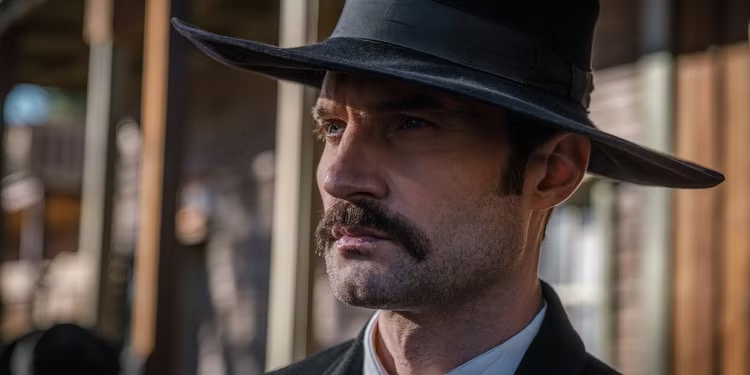
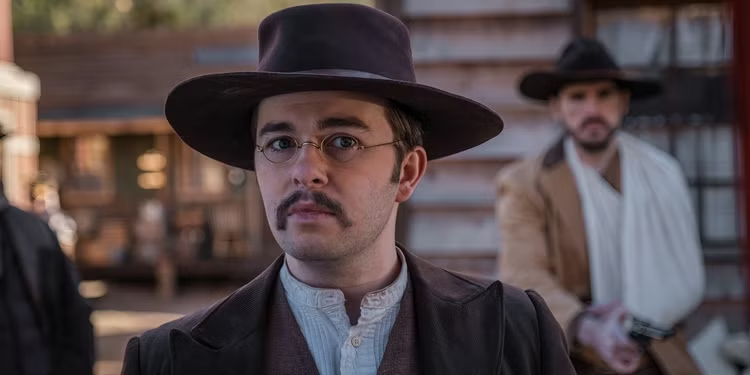
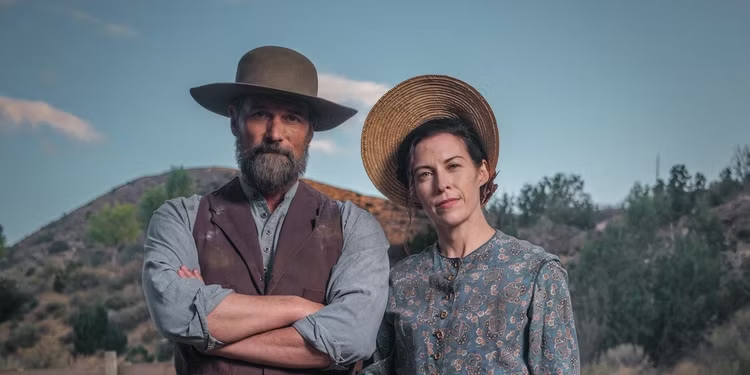
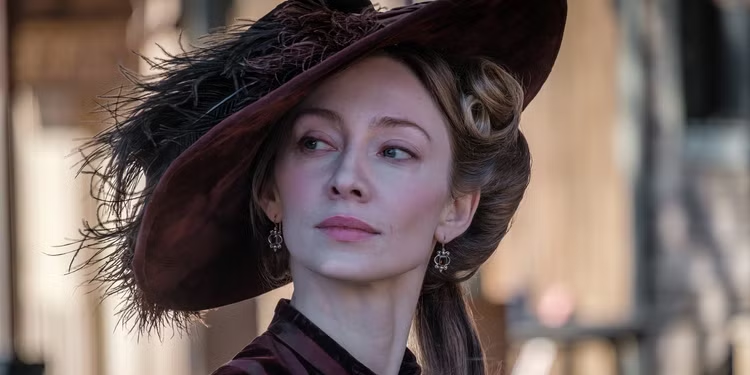
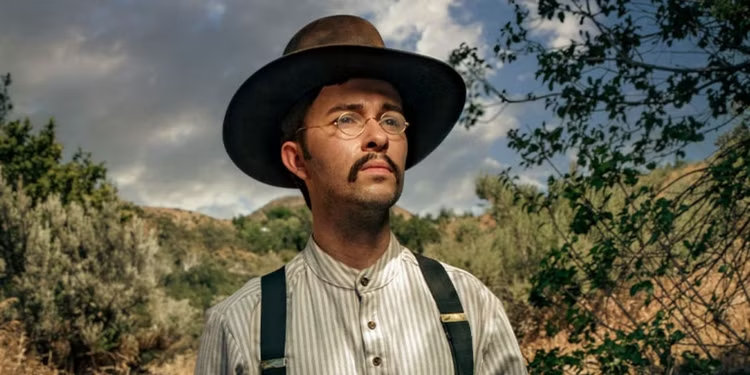
The cast also discussed interesting details about the work that went into building up their characters, all based on real historical figures. The actors dug into their real-life counterparts to build up their respective roles. For Beals, the key was "focusing a lot on this time frame" in particular, and "to not get too into the future [and] try not to project that onto the show." A few tidbits we learned:
To prepare to play Teddy Roosevelt, Beals studied his speeches to get the unique cadence down. He intentionally “toned it down” a little to reflect differences in public speaking versus everyday intonation.
One side effect of that preparation? Beals recently realized, “I sometimes take on his cadence when I’m talking.”
In Ashton Solecki's research on Medora, she noted, "I found her last telegram that she ever sent," adding "it was after the Marquis had passed, and it was a telegram to her children... telling them to always remember their father [...] and to treat each other with love, because that's all that matters at the end of the day."
Jeff DuJardin noted that the Marquis' actual house in Medora, North Dakota (yes, the town was founded by the Marquis and named after his wife) was a "big 26-room mansion on a hill," and "the biggest room in the house is the hunting room: they kept all their guns there, their ammunition, and their hunting supplies."
DuJardin added that the respect between the Marquis and Medora that you see in Elkhorn was very real. "He used to joke and brag about how his wife was an even better shot than he was. Not sure if that's true or not, but that's what he would like to spread around."
The relationship between the Marquis and Medora is interesting for its era. Regarding the Marquis, DuJardin explained, "I think he wanted to be with someone who was always pushing him to be greater and greater, someone who truly believed in him, and someone who was up for an adventure. I don't know if he could have been with anybody else." Solecki felt the same way. "They have an epic love story. They were actually madly in love... they have their own schemes, but it's all for the greater good. They have this great vision of civilizing the place."
Building 'Elkhorn' Like Roosevelt Did: From the Ground Up

The centerpiece of the production on Elkhorn is its detailed reproduction of Teddy Roosevelt's Elkhorn Ranch. It's a beautiful reproduction that allows the team to shoot the series at one key location. A few facts we learned at the set visit:
The ranch was built from the ground up for budget efficiency, and a majority of the series was shot there. Even into the production of Season 2, the crew continued to add to and evolve the site.
The team also built a detailed reconstruction of Roosevelt’s 30’ by 60’ Elkhorn home, based on archived blueprints they found. During our set visit, they showcased the accuracy of materials they used, including knotty pine boards and chainsaw-cut wood when possible.
The look of Elkhorn was inspired by a photograph from the era that was, they discovered later, actually taken by Teddy Roosevelt himself.
Shooting in an accurately built environment produced some interesting conditions for the series' talented cast, but lent accuracy to its production. As Mason Beals described it, “In the first season, it was really like I was on the journey with TR because it was totally wild. We were on horses with guns out in 110-degree weather and period clothing, just sweating bullets… and shooting some blanks, of course. You’re filming a Western and there’s no easy part about that, you’re kind of in the elements as well, [but] it does help you get immersed into it."
For Beals, working with horses was more complex than you'd think. "They say never work with children or animals, and horses feel like a combination of the two sometimes," he added, "although I learned a lot about them. It is definitely like you have to act with the horse."
Ironically, one of co-star Elijah Mahar's favorite elements involved working with the horses. "When you get on that horse and strap on your gun belt..." he added, before Beals responded, "You feel it." Mahar agreed: "As soon as you get on that horse, you're ready to go."
'Elkhorn' and Our Era's Western Resurgence

One part of Elkhorn's success is undoubtedly the resurgence in popularity that the Western genre has seen. As producer Tarpinian explained, there's an elegant simplicity to it all, and it may be appealing in a rapidly changing world:
"On the simplest level, there's something I think that's very reassuring for an audience to know that these stories, all those black and white westerns from the 50s and the 60s, they're almost like passion plays. It's set in the West, but there's good and bad and there's usually a lesson in there. It can be as simple as 'do unto others as you would have them do unto you' or 'don't trust anyone until you verify.' But I think there is something simple about Westerns and how it works, and I think today there's a little bit of nostalgia."
Tarpinian went on to suggest it's a reflection of the moment we’re living in — “in some ways we’re all in the Wild West again,” he said, pointing to the unknowns of technology, AI, politics, even Europe, and descrbing it as “a crazy era,” one that mirrors the adversity of the past — or maybe, he added with a laugh, it’s simply that “people like seeing guys dress up like cowboys, and horses and guns.”
DuJardin said that, given our era's uncertainty, a Western like Elkhorn "gives people a chance to kind of escape, and go back to a time in history where there are a lot of new beginnings, and hope and excitement... there's something special about being able to time travel and go to a different era."
Matt Wiggins noted that the genre's ability to transport audiences is most likely a big part of it. With television getting back to the "basics a bit... people love period pieces," he said. "Not to disparage some of the cool stuff that's going on in film, [like] the whole advent of technology and CG and the Marvel Universe and all these things, but I think some of it's a little overplayed, and I think Westerns take people back to a little simpler [era ...] so Elkhorn was hitting right at the right time."
Beals agreed, noting a growing “desire to revert back to classic storytelling mechanisms” — the kind found in “classic films, [and] classic television.” For him, Westerns and period pieces work because they let you tell “stories that are relatable and human” but from a different angle, one that “amplifies that story.”
What 'Elkhorn' Fans Can Expect in Season 2

Of course, what any Elkhorn fan really wants is a peek into what's next in the world. Tarpinian explained that "the first season, we have to explain to everyone that this isn't the guy in Mount Rushmore; he's 24, 25, and he's got issues like all young people [...] he's thinking about his late wife, it's a terrible tragedy."
This version of Roosevelt is "wracked with survivor's guilt," but Season 2 shows how the Dakotas changed him. After the monumental events and growth of Season 1, "by the time we get to Season 2, he's much more healed, and now it's a little bit more of a classic Western [...] now it's like 'I want a successful ranch, and we're going to bring law into the territory'."
Beals noted that in Season 2, fans can "look forward to some rivalries with some outside influences... there's some people coming together to team up against outer entities. Let's just say enemies become friends, to a degree." Solecki added that Season 2 might see some shifts in the world of Elkhorn:
"I think you are gonna see [...] the balance of power is gonna tip a bit. We may see Marquis a little vulnerable. We may see Medora step into her power, and through that their love, the essence of their love... power is challenged in this season in an unexpected way."
While Roosevelt's time in the region has a real-life ticking clock, Matt Wiggins pointed out that there are elements in William Merrifield's far future that might be interesting for Elkhorn fans to know about:"
"TR was in Medora for one season. Lost almost half or more of his herd that winter, and then he ended up coming back a couple of times, but Merrifield stayed on with the ranch for a while. An interesting little trivia side note for the character is [that] he and TR remained friends throughout their lives, until TR's passing. But once TR became President, he went out to Montana, which is where my character Merrifield ends up moving after he sells his share in Elkhorn Ranch and [Merrifeld] becomes a rancher out there. TR comes out and makes him the Marshal of the Montana territory, so he was the lawman out there, so a very cool little piece of trivia about the character."
When asked if he was pitching a spin-off, Wiggins gave a hearty laugh. "No, no. We're just forecasting the possibilities of the character. I mean, how cool it would be to have a crime drama Western set in Montana?"
Elkhorn Season 2 premieres October 2 on INSP, with one episode dropping each Thursday until November 20.
By Jeff Ewing
Collider
Published Oct 1, 2025